Expired Listings in the Inland Empire: Complete Seller Guide
Expired Listings in the Inland Empire: Why Homes Don’t Sell and How to Fix It
When a home listing expires, sellers usually feel some mix of frustration, confusion, and fatigue. You put the home on the market, lived through showings, waited for offers, and expected movement. Then the listing ended without the result you wanted.
That does not automatically mean the home cannot sell.
In many cases, expired listings in the Inland Empire fail because the strategy did not line up with how buyers are actually behaving in the current market. That can mean pricing was too ambitious, presentation did not support the asking price, or the home never got the right exposure at the right moment. The good news is that an expired listing is not the end of the road. It is usually a signal that the plan needs to be corrected. In the cities you care about most, current conditions still show real demand, but buyers are selective. In February 2026, Redfin reported median sale prices of about $829,000 in Upland, $965,000 in Claremont, $777,500 in Rancho Cucamonga, and $1,025,000 in La Verne. Those are not distressed numbers. They are proof that well-positioned homes can still sell, but not every listing gets rewarded just for showing up.
This guide explains what an expired listing is, why homes expire in Upland, Claremont, Rancho Cucamonga, and La Verne, what sellers often get wrong after expiration, and how to relaunch the home with a stronger plan.
What Is an Expired Listing?
An expired listing is a home that was listed for sale under a signed agreement with an agent, but did not sell before that agreement ended. Once the listing period expires, the seller can usually choose to relist with the same agent, relist with a different agent, or wait.
That part is simple.
What matters more is what expiration actually means in practice. It does not necessarily mean the market rejected the house. More often, it means the market rejected the price-positioning-presenting-marketing combination attached to that house at that time. A different strategy can produce a very different result.

Why Homes Expire in Upland, Claremont, Rancho Cucamonga, and La Verne
Sellers often assume one dramatic problem caused the home not to sell. Usually it is not one big thing. Usually it is a stack of smaller mistakes that work together against the listing.
Upland
Upland remains a competitive market, but not one where sellers can ignore precision. Redfin reports homes in Upland receive an average of three offers and sell in about 48 days, with a median sale price of $829,000 in February 2026. Zillow puts average Upland home value around $815,217, with homes going pending in about 23 days. That gap tells an important story: good homes can move, but weaker listings can sit longer than sellers expect.
Claremont
Claremont tends to attract buyers who are more quality-conscious and value-sensitive at the same time. Redfin shows a median sale price of $965,000 in February 2026, down 8.1 percent year over year, with average days on market around 29. That means sellers in Claremont cannot rely on prestige or neighborhood reputation alone. Buyers still compare closely.
Rancho Cucamonga
Rancho Cucamonga had a median sale price of about $777,500 in February 2026, according to Redfin, with homes selling in about 47 days, slower than the year before. Zillow shows average home value around $782,617 and homes going pending in roughly 21 days. That suggests there is still solid activity, but not unlimited patience from buyers.
La Verne
La Verne sits at a higher price tier in many segments, which means sellers need even tighter alignment between price, condition, and buyer expectations. Redfin shows a median sale price of $1,025,000 in February 2026 and average market time around 35 days, while Zillow places average home value around $940,085. Buyers at this level usually notice when a home is even a little out of sync with value.
Across the Inland Empire, the broader environment also matters. Realtor.com’s 2026 forecast expects for-sale inventory to keep recovering, up nearly 9 percent year over year nationally, while California statewide data for March 2026 shows median days on market at 44 days and active listings up 2.64 percent year over year. Current mortgage rates also remain meaningful friction. AP reported the average 30-year fixed rate at 6.38 percent for the week of March 26, 2026. More inventory plus higher borrowing costs means buyers often take longer, compare harder, and punish overpricing faster.
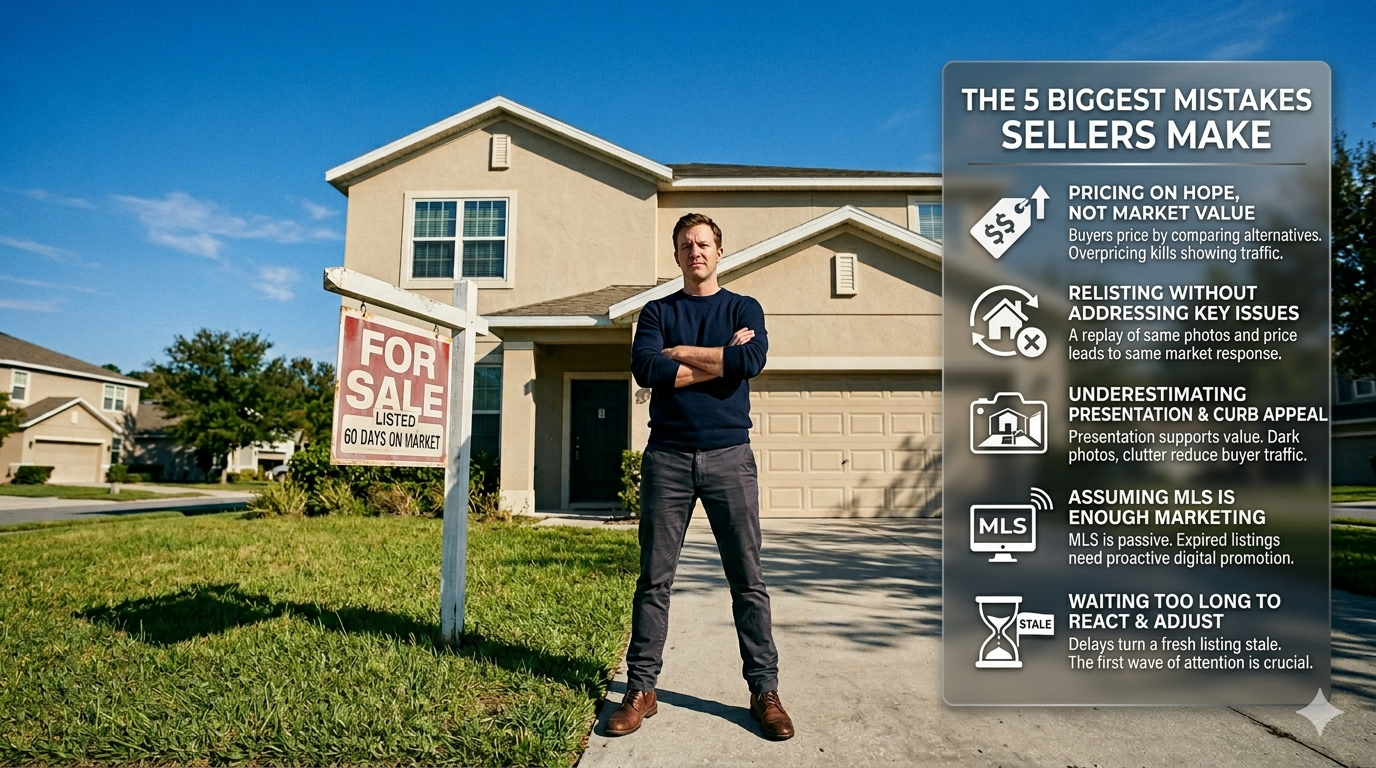
The 5 Biggest Mistakes Sellers Make
1. Pricing from hope instead of the market
This is still the biggest one.
A seller may believe the home is worth more because of upgrades, pride of ownership, or what they need to net. Buyers do not price that way. They compare your home against alternatives they can buy right now. If your home is even slightly above where buyers see obvious value, showings can slow down quickly. Once that happens, the first wave of attention starts slipping away.
2. Relisting without actually fixing the problem
Some sellers relaunch too quickly with nearly the same price, same photos, same presentation, and same overall positioning. That is not a relaunch. That is a replay.
If the market barely sees a difference, the market often responds the same way.
3. Underestimating presentation
Presentation is not fluff. It is value support.
If the home asks for strong money, it needs to look like it deserves strong money. Dark photos, cluttered rooms, unfinished repairs, dull copy, weak staging, or poor curb appeal can quietly drag down buyer interest before the first showing ever happens.
4. Assuming MLS exposure is enough
MLS exposure is necessary. It is not the whole job.
A listing that depends entirely on passive visibility may miss buyers who need stronger digital promotion, better storytelling, email outreach, or video and social amplification. Marketing failures on expired listings are often ordinary rather than dramatic. That is what makes them sneaky.
5. Waiting too long to react
If the home is not getting enough traffic, if the feedback sounds repetitive, or if the online response is weak, adjustments should come early. Waiting too long can turn a normal listing into a stale listing.
Redfin reported today that more than half of February 2026 listings nationwide had been on the market at least 60 days without going under contract, the highest share since 2019. Staleness has real consequences.
Pricing vs Presentation: What Actually Matters
Both matter. Pricing usually matters first.
A beautifully presented home can still fail if buyers think it is overpriced. At the same time, a well-priced home can underperform if it looks average online and uninspiring in person.
My view is simple: pricing opens the door, presentation gets buyers emotionally invested, and marketing creates enough exposure for both to matter.
If I had to rank them in order of importance on most expired listings, I would say:
pricing
presentation
marketing execution
But those three work like gears. If one gear slips badly enough, the whole system loses power.
What Buyers Think About Expired Listings
Most sellers overestimate how much buyers care about the fact that the listing expired.
Buyers usually are not fixated on your listing history. They are asking a more basic question: does this home make sense for me at this price, in this condition, compared with the alternatives?
If the relaunch includes a meaningful improvement in value perception, buyers often view the property as a fresh opportunity. If the relaunch feels recycled or defensive, buyers may assume the original issues remain.
That is why sellers need to focus less on embarrassment and more on repositioning.
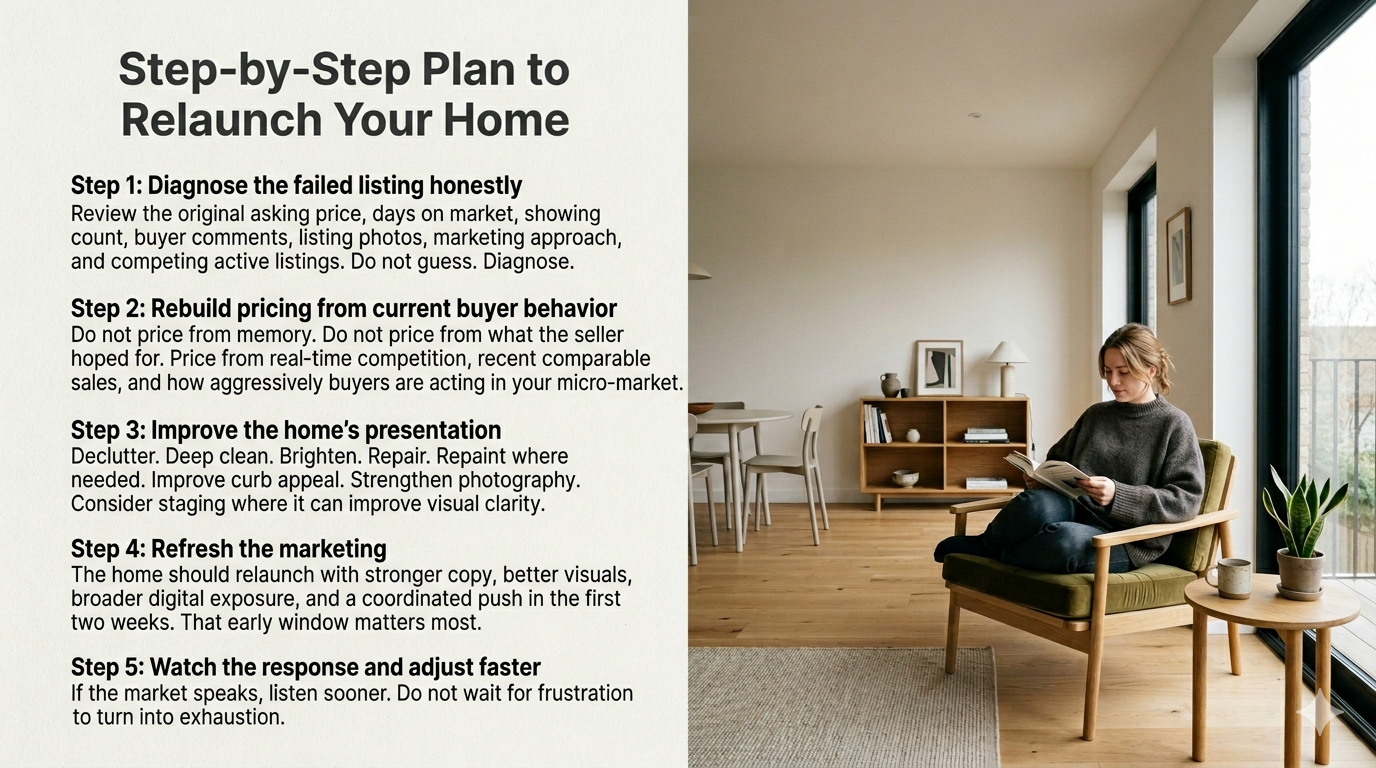
Step-by-Step Plan to Relaunch Your Home
Step 1: Diagnose the failed listing honestly
Review the original asking price, days on market, showing count, buyer comments, listing photos, marketing approach, and competing active listings. Do not guess. Diagnose.
Step 2: Rebuild pricing from current buyer behavior
Do not price from memory. Do not price from what the seller hoped for. Price from real-time competition, recent comparable sales, and how aggressively buyers are acting in your micro-market.
Step 3: Improve the home’s presentation
Declutter. Deep clean. Brighten. Repair. Repaint where needed. Improve curb appeal. Strengthen photography. Consider staging where it can improve visual clarity.
Step 4: Refresh the marketing
The home should relaunch with stronger copy, better visuals, broader digital exposure, and a coordinated push in the first two weeks. That early window matters most.
Step 5: Watch the response and adjust faster
If the market speaks, listen sooner. Do not wait for frustration to turn into exhaustion.
Two Real-World Style Examples
One seller in a higher-price pocket relisted quickly because they believed the first listing just had bad timing. They kept the price almost the same, changed very little visually, and went back out. The result was almost identical. Same low traction. Same weak urgency. Same disappointment.
Another seller took a more disciplined route. They re-evaluated price against live competition, made targeted cosmetic improvements, upgraded photography, and relaunched with a better digital rollout. The house did not need a miracle. It needed clearer value and stronger execution.
That is the difference.
Should You Switch Agents After Expiration?
Sometimes yes. Sometimes no.
The better question is whether the strategy for the next launch is materially different from the first one. If the same agent can provide a meaningfully stronger pricing plan, better marketing, sharper presentation guidance, and more responsive execution, staying put can make sense. If the next plan sounds like a polite remix of the old one, that is a problem.
So I do not think sellers should obsess over changing agents as the headline issue. I think they should obsess over changing the quality of the strategy.
How the Inland Empire Market Affects Your Sale
This guide is intentionally evergreen, but current conditions still matter.
Across the Inland Empire and nearby foothill cities, sellers are operating in a market where prices are still respectable, but buyers have become more disciplined. Upland is around $829,000 median sale price, Claremont about $965,000, Rancho Cucamonga about $777,500, and La Verne about $1,025,000 in the latest Redfin data. Statewide California market data shows 44 median days on market and more active listings than a year ago, while mortgage rates remain elevated near 6.38 percent. That combination does not scream collapse. It screams selectivity. Homes that are priced right and launched well can still succeed. Homes that miss the mark can get ignored longer than sellers expect.
That is why expired listings Inland Empire sellers struggle with are often not about whether there is demand at all. They are about whether the listing was aligned with the kind of demand that exists now.
Key Takeaway
If your listing expired in Upland, Claremont, Rancho Cucamonga, La Verne, or elsewhere in the Inland Empire, do not treat that outcome like a final verdict on your home.
Treat it like feedback.
Most expired listings happen because price, presentation, and marketing did not work together strongly enough to create buyer action. Fix those three areas, relaunch with intention, and many homes that failed the first time can sell successfully the second time.
Strategic Takeaway for Sellers
If your home did not sell, it does not mean the market rejected you. It means the strategy missed the mark.
When pricing, presentation, and marketing work together, buyers respond. A thoughtful relaunch can turn an expired listing into a successful sale without chasing the market downward.
If you want a clear diagnosis of what went wrong and a plan to relaunch correctly, a calm conversation can bring everything into focus.
📱 Call or text: 909-319-8338
🌐 Website: soldbypaulvyhnalek.com
📅 Schedule a call: soldbypaulvyhnalek.com/schedule-call
✉️ Email: [email protected]
FAQ
Do expired listings sell for less?
Not automatically. An expired listing can still sell at a strong number if the relaunch improves pricing accuracy, presentation, and market exposure. Sellers usually lose more money through poor positioning than through the fact of expiration itself.
Should I relist immediately?
You can, but only if the relaunch is meaningfully better than the original listing. Fast is not always smart. Better is smart.
How do I fix a failed listing?
Start with diagnosis. Review price, buyer feedback, showings, presentation, and competition. Then relaunch with sharper pricing, stronger visuals, and better promotion.
Why listings expire in Upland, Claremont, Rancho Cucamonga, and La Verne?
Usually because the home entered the market priced above current buyer expectations, presentation did not fully support the asking price, or marketing was not strong enough to create the right momentum. Current local data shows buyers are active in all four cities, but not careless.


