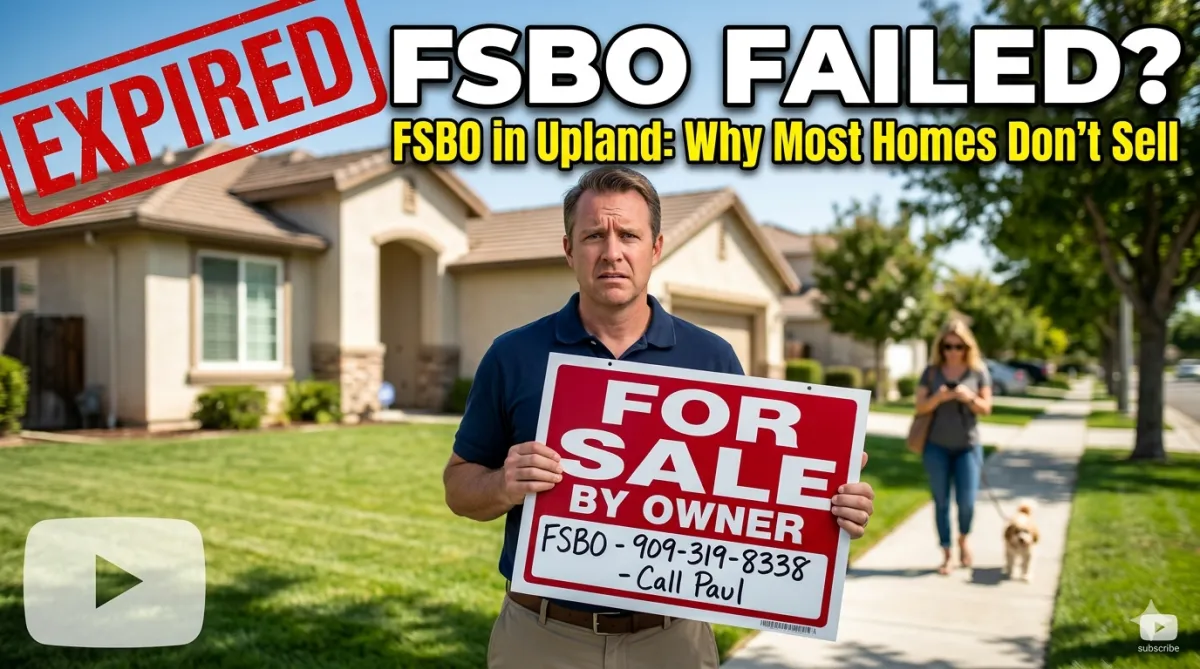
FSBO in Upland: Why Most Homes Don’t Sell (And Fix It)
FSBO in Upland: Why Most Homes Don't Sell
Selling your home yourself sounds simple, until it doesn't sell. FSBO listings in Upland often miss key buyer signals that experienced agents know to watch for.
Every year, a meaningful number of Upland homeowners decide to list their property themselves. The reasoning is straightforward: skip the commission, keep more money, handle the process on your own terms. It sounds sensible. And in theory, there is nothing stopping a determined seller from pulling it off.
In practice, the numbers tell a different story. The vast majority of For Sale By Owner listings either sit on the market far longer than comparable agent-listed homes or get pulled without a sale at all. Some eventually come back on the market through an agent. Others sell below what a properly marketed property would have earned. Very few achieve what the seller originally hoped for.
So what keeps going wrong? The answer is rarely about effort. Most FSBO sellers work hard. They take photos, post on popular listing sites, hold open houses, and respond to inquiries. The problem runs deeper than effort, and it shows up in four consistent patterns.
Why Buyers Approach FSBO Differently
When a buyer sees a home listed without an agent, their interpretation of that signal matters. Many assume the seller is testing the market, not yet fully committed, or priced high and unwilling to negotiate through a professional process. That perception alone changes how seriously a buyer engages.
Buyers who work with agents sometimes avoid FSBO listings altogether. Their agent may not reach out to schedule a showing, not out of obstruction, but because coordinating directly with a private seller involves extra steps that unrepresented transactions routinely complicate. Buyers also know that when both sides lack representation, the contract, contingencies, and disclosure process can become messy fast. Many simply move on to the next listing rather than navigate that uncertainty.
Even motivated buyers who genuinely like a FSBO home often approach it with more hesitation, lower offers, and more contingencies than they would present to a listed property with professional representation on both sides.
In Upland specifically, the buyer pool for mid-range and move-up properties is competitive. Those buyers have options. When a home feels like it carries additional transaction risk, they usually find something else. FSBO sellers often interpret low showing volume as a pricing problem when the real issue is that fewer buyers are walking through the door to begin with.
The Pricing Gap Most Owners Don't See
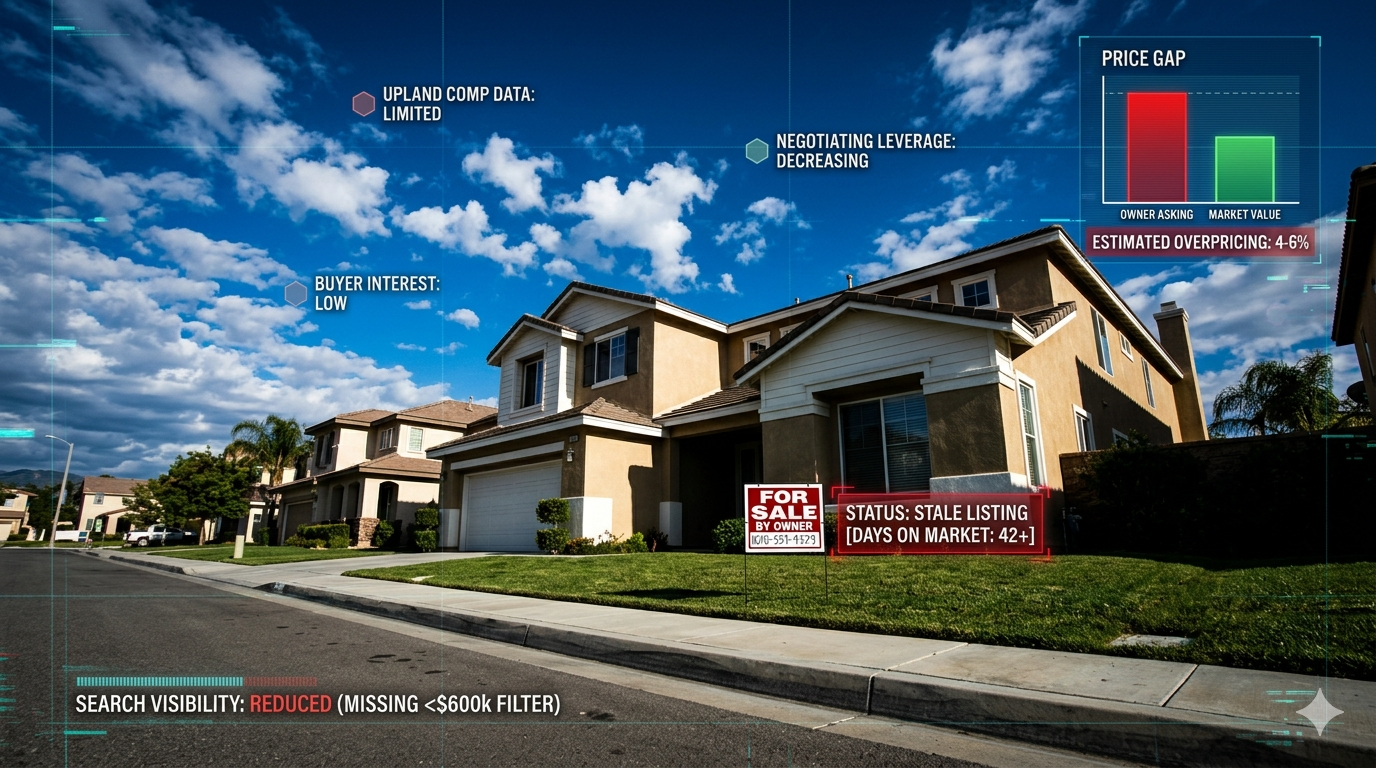
Pricing a home accurately requires data that most owners don't have easy access to, and experience interpreting that data in a way that the current Upland market actually reflects. Homeowners generally start with one of two reference points: what their home feels worth to them emotionally, or what they believe they need to net after expenses.
Neither of those is what buyers use. Buyers compare your home to every other active listing in your price range, and to recent sales that closed in the past 60 to 90 days. If your price sits above where the comparable data lands, even slightly, you will get overlooked in searches. Online search filters are unforgiving. A home priced at $605,000 misses every buyer searching under $600,000, even if a small adjustment would have put it in front of dozens of qualified buyers.
The more common FSBO pricing mistake is not dramatic overpricing but modest overpricing, the kind that feels defensible. Sellers point to a neighbor's sale six months ago, or to upgrades they've made, or to what they've seen in other neighborhoods. These comparisons rarely hold up under a real market analysis. And modest overpricing is in some ways harder to correct than obvious overpricing because sellers are slower to recognize it.
Homes that sit on the market beyond three to four weeks in Upland begin to attract a different kind of buyer attention: the ones looking for leverage. A stale listing becomes a negotiating opportunity for buyers, which tends to push the final sale price further below where it started.
Sellers who overprice by 3 to 5 percent often end up selling below where a correctly priced home would have landed. The carrying costs, the price reductions, and the weaker negotiating position combine to produce outcomes that would have been avoided with accurate pricing from the start.
Marketing Limitations That Kill Exposure
The most significant structural disadvantage of FSBO is access to the Multiple Listing Service. While some FSBO sellers pay a flat fee to get their home onto the MLS, most do not take full advantage of how that listing is positioned, photographed, or marketed beyond the basic entry. The MLS is the feed that drives Zillow, Realtor.com, Redfin, and every major real estate search platform. A weak MLS listing produces weak results everywhere simultaneously.
Professional photography is one of the most documented differences between agent-listed and FSBO homes. Buyers begin their search online, and the photos are the first showing. Listings with low-quality images, poor lighting, or unflattering angles receive fewer saved favorites, fewer showing requests, and less engagement overall. Most homeowners photograph their own homes in ways that feel accurate to them but fail to present the space the way a buyer processes it.
Beyond photography, agents bring buyer networks, relationships with other agents who may have clients actively looking, and the ability to signal urgency through properly timed marketing. A well-marketed Upland home generates early momentum that FSBO listings rarely replicate. When a new listing hits the market with strong presentation and professional outreach, it creates the kind of early activity that leads to multiple offers. That window is narrow, typically the first two weeks, and it cannot be recovered once it closes.
FSBO sellers also manage every inquiry, showing request, and follow-up themselves. That workload is more demanding than anticipated, and inconsistent responsiveness can cost showings. Buyers and their agents move quickly. Delayed replies or missed calls sometimes lead them directly to the next property.
When FSBO Sellers Finally Switch
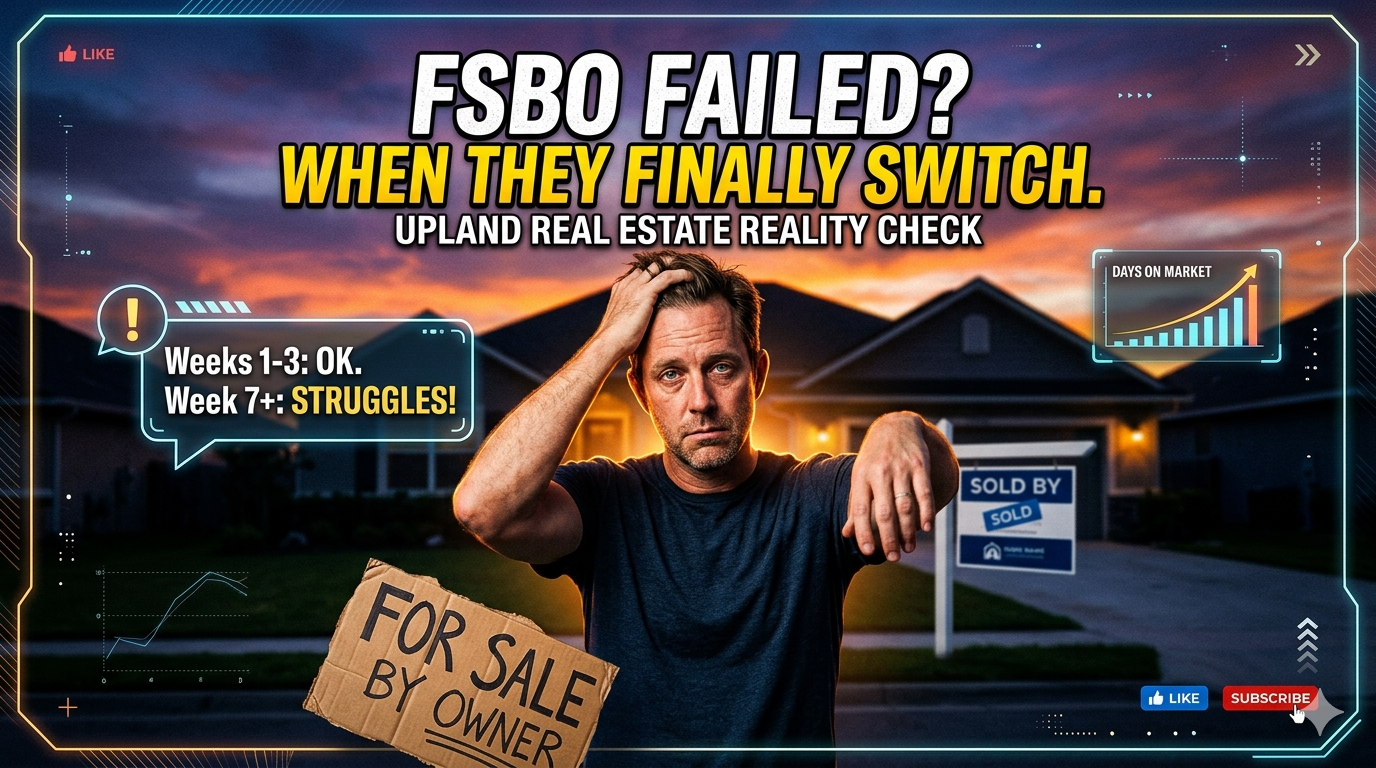
There is a recognizable pattern among Upland homeowners who attempt FSBO and eventually list with an agent. The first few weeks feel manageable. Inquiries come in, some showings happen, and sellers remain optimistic. By weeks three and four, the pace slows. By week six or seven, something shifts in how sellers talk about the process. The energy changes from confidence to exhaustion.
At that point, the calculation changes. Sellers who were committed to avoiding a commission begin to weigh that cost against continued carrying expenses, continued market exposure with diminishing returns, and the mounting stress of managing a transaction they were not fully equipped for. Most eventually conclude that professional help is worth more than they initially gave it credit for.
The problem is that switching later carries a cost. By the time many FSBO sellers list with an agent, their home has accumulated days on market that work against them. Buyers see the history. They know the home has been available for two months. That knowledge influences what they offer and how hard they negotiate. A listing that starts fresh with an agent from day one operates from a fundamentally stronger position than one relisted after a failed FSBO attempt.
That is not to say the situation is unrecoverable. Skilled agents have relisted previously stale FSBO homes and achieved strong results through repositioning, updated marketing, and strategic timing. But those outcomes require more work and more time than a clean launch would have. The sellers who do best are the ones who ask the right questions before they list, not after the first attempt fails.
See what full-market exposure looks like for your home
Curious what your home would look like with professional marketing, accurate pricing, and real buyer reach? Let's review it together.
Let's review it together ↗
📱 Call or text: 909-319-8338
🌐 Website: https://soldbypaulvyhnalek.com
📅 Schedule a call: https://soldbypaulvyhnalek.com/schedule-call
✉️ Email: [email protected]


